Texas – Texas Sen. Ted Cruz accused Tucker Carlson of trying to “rehabilitate communism,” arguing that the Russian economy is in poor condition as he backed former British government minister Sir Jacob Rees-Mogg in his dispute with the conservative commentator.
“Tucker Carlson is trying to rehabilitate communism. Sir Jacob Rees-Mogg is right—the Russian economy is an absolute disaster! Tucker should put on a clown suit, because he was clowning reality,” Cruz wrote in an Oct. 12 post on X.
The Republican senator made the remarks while promoting the latest episode of his podcast, Verdict with Ted Cruz, titled “In Defense of Western Civilization: Sir Jacob Rees-Mogg One-on-One.” The episode features Cruz, co-host Ben Ferguson and Rees-Mogg discussing Carlson’s interview with the former British minister, including disagreements over Russia’s economy, Western military preparedness and the historical record of World War II.
Cruz published a second post on X the same day, highlighting the conversation and arguing that history demonstrates the dangers of isolationism.
“History shows us that isolationism does not work,” Cruz wrote. “When a nation is not prepared, it becomes an attractive target.”
The comments followed widespread attention surrounding Carlson’s interview with Rees-Mogg, which drew criticism over their exchange about Britain’s decision to fight Nazi Germany during World War II.
The Guardian reported on Oct. 4 that Rees-Mogg accused Carlson of “verging on defending Hitler” during their discussion. Carlson questioned why Britain had fought Germany and challenged the argument that entering the war had been worth the costs associated with the conflict.
Rees-Mogg defended Britain’s decision to fight, arguing that the war represented a fundamental struggle between good and evil. He also warned that a German victory could have left Britain vulnerable to invasion and German domination.
The exchange attracted additional attention from American media outlets. Mediaite reported on Oct. 2 that Carlson repeatedly questioned Rees-Mogg about Britain’s decision to fight Nazi Germany, including asking why the country had entered the conflict. The Washington Examiner also covered the interview, reporting on Carlson’s questions about whether Britain was better off after the war.
The controversy subsequently expanded beyond the historical debate to include Carlson’s statements about Russia and its economic strength.
During the interview, Carlson argued that Russia had a much larger economy than Britain, pointing to the country’s natural resources, manufacturing capacity and overall wealth. Rees-Mogg disputed that assessment, arguing that Russia’s economy was smaller than the United Kingdom’s when measured by gross domestic product.
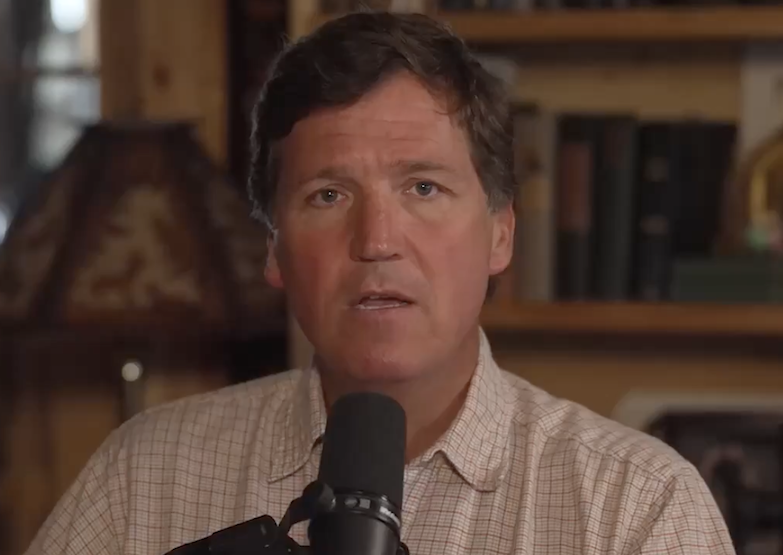
In the Verdict episode, Cruz revisited that disagreement and backed Rees-Mogg’s assessment.
Cruz cited nominal gross domestic product figures of approximately $4.24 trillion for the United Kingdom and $2.65 trillion for Russia, arguing that Britain’s economy was substantially larger despite Russia’s much larger population and territory.
He also compared the countries’ GDP per capita, citing approximately $61,000 for Britain and $18,500 for Russia. Cruz used those figures to argue that Russia’s natural resources and population had not translated into comparable economic prosperity for its citizens.
The senator argued that Carlson’s portrayal of Russia overlooks the economic weaknesses associated with the country’s political and economic system. He connected the dispute to a broader ideological argument, claiming that Carlson’s comments risked presenting Russia and its political model in a more favorable light than the evidence justified.
The Washington Examiner also addressed the economic disagreement in an Oct. 6 analysis, challenging Carlson’s portrayal of Russia as economically stronger than Britain and highlighting the difference between the countries’ nominal GDP figures.
The podcast also examined the consequences of isolationism and the importance of maintaining military readiness. Cruz and Rees-Mogg argued that countries that fail to prepare for potential threats can encourage adversaries to test their defenses.
That argument formed a central part of Cruz’s second Oct. 12 post, in which he promoted the interview as a discussion about the lessons of history and the importance of Western security cooperation.
Beyond Russia and World War II, the conversation addressed international security, relations between the United States and the United Kingdom, China’s ambitions toward Taiwan and the cultural and constitutional traditions that the participants said had contributed to Western freedom and prosperity.
The episode came amid continued debate over Carlson’s political commentary and his approach to foreign policy. His interview with Rees-Mogg generated criticism from commentators who argued that questioning Britain’s role in defeating Nazi Germany risks minimizing the nature of Hitler’s regime and the consequences of a Nazi victory.
In an Oct. 9 opinion article, The Washington Post published criticism from Poland’s chargé d’affaires to the United States, Bogdan Klich, who warned against the reemergence of historical narratives that distort the circumstances surrounding Nazi Germany’s invasion of Poland. The article argued that such narratives can also affect contemporary debates about territorial aggression and international security.
Cruz’s remarks bring the argument back to the broader question of how the United States and its allies should respond to authoritarian governments and emerging security threats.
By criticizing Carlson’s characterization of Russia and emphasizing the importance of military preparedness, the Texas senator used the podcast to make a wider case against isolationism and what he views as an overly favorable portrayal of Russia’s political and economic system.