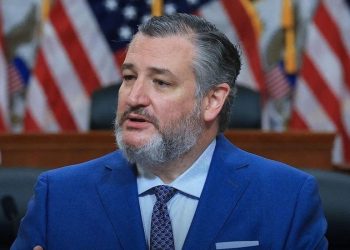
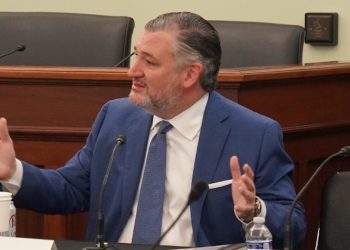
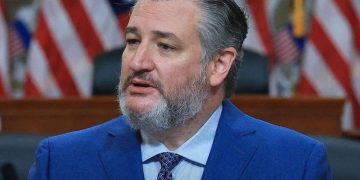
Texas – Texas Sen. Ted Cruz is escalating his criticism of Democratic Michigan Senate candidate Abdul El-Sayed, accusing him of having longstanding ties to the Muslim Brotherhood and warning that his election could create a national security risk if he gains access to classified intelligence.
In a post on X, Cruz argued that evidence from El-Sayed’s past writings, statements by his half-sister and alleged connections involving members of his family raises serious concerns about the Democrat’s background and potential role in the U.S. Senate.
“The evidence overwhelmingly demonstrates that Abdul El-Sayed is a strong and lifelong supporter of the Muslim Brotherhood,” Cruz wrote, before listing several claims he said support his accusation. Cruz specifically pointed to a 2011 opinion article written by El-Sayed, social media posts from his half-sister, his biological mother’s former employment and his father-in-law’s involvement with the Islamic Society of North America (ISNA). The Texas Republican also raised concerns about the possibility of El-Sayed serving on the Senate Intelligence Committee if Democrats gain control of the chamber.
“When you get elected to the Senate, there is no security clearance process. None. Nothing stops Chuck Schumer from putting El-Sayed on the Intelligence Committee,” Cruz wrote. “There is a very real risk that Americans will die as a result.” Cruz’s comments came as Republicans intensified their criticism of El-Sayed during the final days of the Michigan Senate campaign, where the Democrat is facing Republican nominee Mike Rogers in a closely watched race to replace retiring Democratic Sen. Gary Peters.
CBS News reported October 28 that Cruz had made similar accusations during a campaign event outside Detroit, where he attempted to connect El-Sayed to the Muslim Brotherhood and questioned whether he could be trusted with sensitive national security information.
At the event, Cruz referred to El-Sayed as a “jihadist leprechaun” and argued that the candidate could potentially obtain access to intelligence information if elected and appointed to the Senate Intelligence Committee.
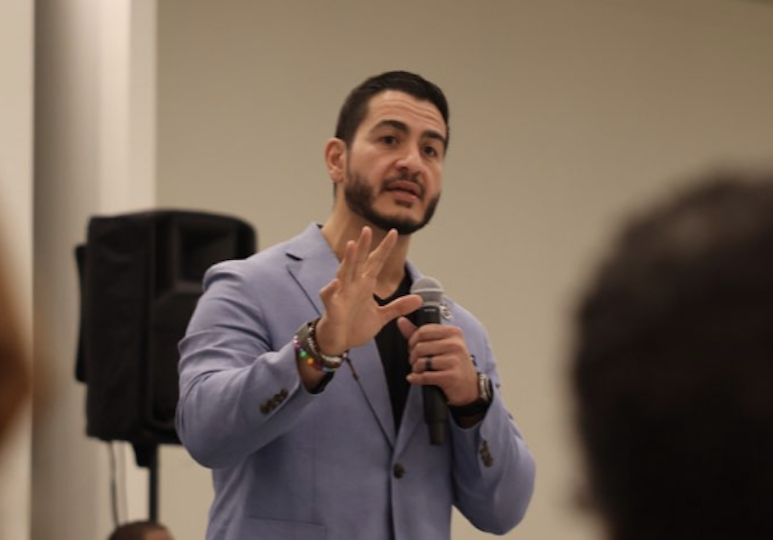
Cruz also suggested that El-Sayed could potentially alert individuals connected to terrorist organizations if he learned about intelligence operations targeting them.
The controversy surrounding El-Sayed’s alleged connections to the Muslim Brotherhood has been fueled in part by social media posts published years ago by his half-sister, Eman Abdelhadi.
In posts from 2012, Abdelhadi described her family’s relationship with the organization, writing that her family had “long been MB” and discussing a conversation with their mother about her alleged activism in the Muslim Brotherhood during the early 1970s.
CBS News reported that El-Sayed’s biological mother, Fatten Elkomy, worked as a nurse for the Islamic American Relief Agency (IARA), a nonprofit that was shut down by federal authorities in 2004 after investigators determined it had violated sanctions and provided assistance to al-Qaeda and other terrorist organizations.
The FBI raided the organization’s offices in Missouri in October 2004. However, CBS News specifically reported that Elkomy was not accused of wrongdoing in connection with the organization.
Cruz also referenced El-Sayed’s father-in-law, Tayeb Jukaku, who served on the founders’ committee of ISNA. The organization, along with the Council on American-Islamic Relations (CAIR), was named as an unindicted co-conspirator in the 2007 Holy Land Foundation terrorism-financing case involving more than $12 million funneled to Hamas. Neither ISNA nor CAIR was charged with a crime in that case, and both organizations have denied wrongdoing.
The Washington Post, which examined the allegations surrounding El-Sayed’s background, reported that Republicans have also pointed to his involvement with the University of Michigan’s Muslim Students Association and a 2012 open letter supporting Egyptian President Mohamed Morsi.
Morsi was a senior figure in the Muslim Brotherhood and represented its political wing. El-Sayed was among the signatories of the letter supporting Morsi’s government and calling for the removal of officials associated with the previous Egyptian dictatorship.
The Washington Post also examined a 2011 opinion piece in which El-Sayed argued that concerns about the Muslim Brotherhood gaining power in Egypt following the Arab Spring protests were overstated.
However, the newspaper reported that Republicans had not produced evidence demonstrating that El-Sayed personally belonged to the Muslim Brotherhood or had formally pledged his support to the organization.
El-Sayed has repeatedly rejected the allegations, saying he has never been a member of the Muslim Brotherhood and has no ties to the organization.
“I have never been a member of the Muslim Brotherhood, I never will be a member of the Muslim Brotherhood,” he told Fox News, according to CBS News.
He has also argued that Republicans are attempting to use his religious background and family connections against him rather than focusing on his political record and policy proposals.
“My mom and my sister are not running for office. I’m running for office. Judge me by my actions and my work,” El-Sayed said during an October 16 campaign appearance in Michigan.
His campaign has described the accusations as a bigoted anti-Muslim smear campaign intended to distract voters from economic issues.
The Associated Press has also reported on the growing controversy, noting that El-Sayed’s candidacy has become a focal point of Republican attacks over his religion, family background and alleged connections to Islamist organizations. The AP reported that there is no evidence establishing that El-Sayed himself has any affiliation with the Muslim Brotherhood.
The organization, founded in Egypt in 1928, has branches and affiliated movements operating in several countries. The Trump administration designated certain branches as terrorist organizations, although the designations do not apply automatically to every organization or individual associated with the broader movement.
Cruz’s latest comments add to an increasingly contentious national debate surrounding El-Sayed’s candidacy, with Republicans arguing that his alleged associations raise questions about national security while the Democrat maintains that the accusations are unfounded and that he should be judged by his own actions.
The Michigan Senate race is among the contests that could determine control of the U.S. Senate following the November 3 midterm elections.