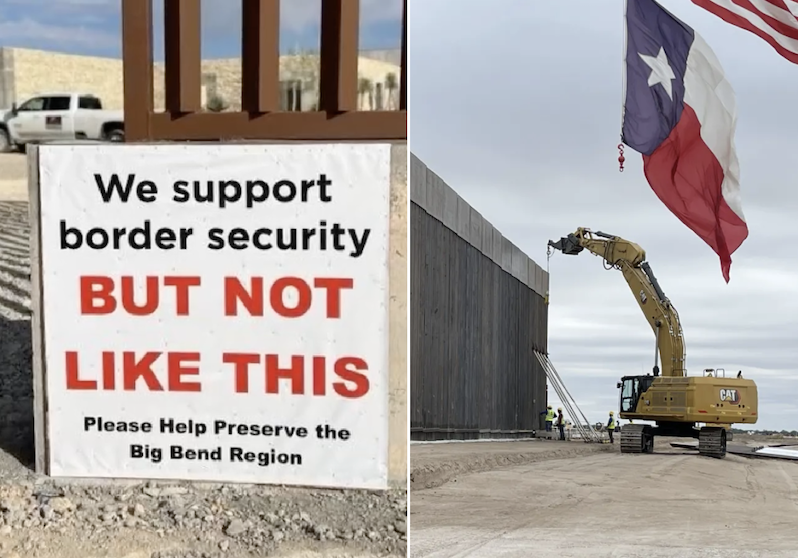
Texas – The expansion of the border wall along the Texas-Mexico border under the Trump administration has continued to generate strong political backlash in West Texas, particularly in environmentally sensitive areas near Big Bend National Park.
The project, which is part of a broader federal push to increase physical and technological barriers along the southern border, has drawn criticism from local residents, environmental organizations, landowners, and some elected officials who argue the construction threatens both the region’s ecology and long-standing community interests.
According to reporting from The Guardian, federal crews have been active in remote areas of West Texas, including near Chispa Road in the Big Bend region, where preparations for wall construction and associated infrastructure have intensified. The area is widely regarded as one of the most ecologically diverse and least trafficked sections of the U.S.-Mexico border.
The Trump administration has defended the expansion as part of a broader national security strategy funded through large federal allocations for border infrastructure. Officials have argued that increased enforcement measures are necessary to address illegal crossings and strengthen border security.
However, critics say the Big Bend region does not reflect typical border enforcement conditions. Migration levels in the area are among the lowest along the entire southern border, with federal data showing that the Big Bend sector accounts for only a small fraction of total apprehensions each year. This has fueled arguments that the construction is unnecessary and disproportionately disruptive.
Local opposition has grown steadily. Residents, ranchers, and business owners have expressed concern that the wall could divide private property, disrupt tourism, and damage ecosystems that are central to the region’s identity and economy. Environmental groups have also warned that construction could harm wildlife corridors, affect endangered species, and alter natural river systems along the Rio Grande.
In addition to local resistance, legal challenges have been filed against the federal government. Advocacy groups, including conservation organizations and local stakeholders, have argued that the administration bypassed environmental review requirements by invoking federal waivers to accelerate construction. One lawsuit filed in the Western District of Texas claims that the government’s actions violate environmental law and exceed executive authority.
The controversy has also drawn bipartisan attention. Some Republican and Democratic local officials in border counties have voiced concern that the wall expansion lacks transparency and does not take into account the geographic and environmental realities of West Texas. Several sheriffs and county leaders have instead advocated for technology-based border security measures, such as surveillance systems and targeted enforcement, rather than physical barriers across rugged terrain.
Public demonstrations have also taken place across Texas, including protests near the state capitol and in communities directly affected by proposed construction. Organizers have described the opposition as unusually broad, bringing together environmental activists, landowners, and residents who rarely align politically.
Federal officials, meanwhile, have maintained that border security requires a combination of infrastructure and technology. Customs and Border Protection has previously indicated that in some remote areas, including parts of Big Bend, alternative solutions such as detection systems may be considered due to terrain challenges and environmental sensitivity.
Despite ongoing debate and legal pressure, construction and planning efforts have continued, leaving the future of the project in West Texas uncertain. While some sections of the border wall have advanced, others remain under review amid growing public scrutiny and shifting federal strategies.
The debate over the border wall in West Texas has become emblematic of broader national divisions over immigration policy, environmental protection, and federal authority. As legal challenges continue and political tensions rise, the region remains at the center of one of the most contentious infrastructure projects in the United States.