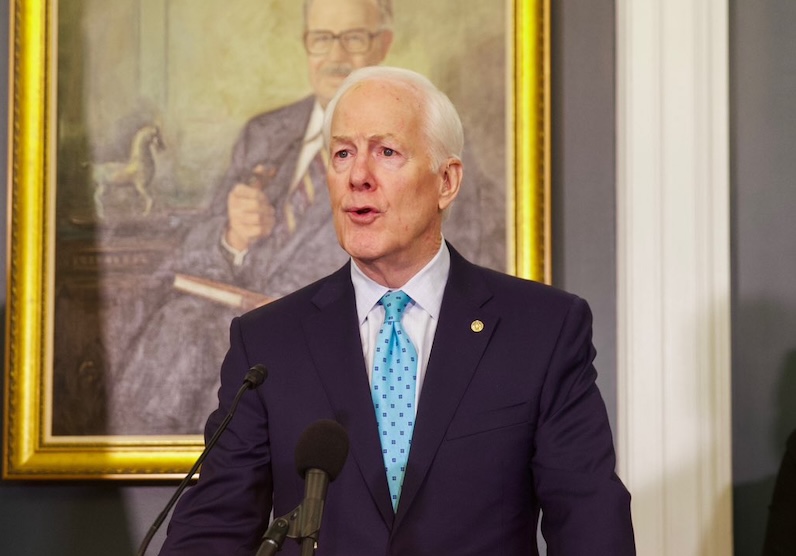
Texas – John Cornyn is urging the Trump administration to address concerns raised by Texas residents and local officials before moving ahead with border barrier construction in and around Big Bend National Park and Big Bend Ranch State Park.
In a letter to Homeland Security Secretary Markwayne Mullin, Cornyn said he supports securing the southern border but warned that planned physical barriers could create unnecessary impacts in areas where the region’s natural terrain already makes illegal crossings difficult.
“I will always support securing our border, but local officials on both sides of the aisle & other stakeholders have shared with me concerns about potential impacts in areas where the terrain already acts as deterrence for illegal crossings, whether it be 1,000-foot riverbank cliffs, deep canyons, or deserts,” Cornyn said.
The Republican senator said the Department of Homeland Security should coordinate directly with Texas stakeholders before proceeding with physical barriers in the region, Statesman reported.
Cornyn’s concerns come as federal contractors have begun work associated with the Trump administration’s broader border security plans around Big Bend National Park. Recent reports have described road work, land clearing and preparations for border security infrastructure near areas including Santa Elena Canyon.
The project has generated unusual bipartisan opposition in Texas, with local officials, landowners, conservation advocates and lawmakers raising concerns about the potential effects on the region’s landscape, wildlife, tourism and cultural sites.
According to KERA, Cornyn’s letter called on DHS to meet with local leaders, landowners and other stakeholders before additional construction moves forward. The senator said concerns had been raised by a bipartisan group of border sheriffs and county judges, private landowners and park advocates.
The Big Bend region presents a unique challenge for border security because of its rugged geography. Parts of the border include steep cliffs, deep canyons and large stretches of desert, conditions that Cornyn said can already serve as significant deterrents to illegal crossings.
The senator’s position was not a call to abandon border security efforts altogether. Instead, Cornyn argued that federal officials should consider the specific characteristics of the region before installing physical barriers.
The debate has intensified as construction activity has become visible inside Big Bend National Park. The Houston Chronicle reported that the Trump administration had moved away from an initial proposal for a 30-foot wall in the park and instead planned less-obtrusive vehicle barriers in certain areas. The broader project also involves patrol roads, surveillance technology and security lighting, Houston Chronicle reported.
The newspaper reported that the administration’s current plans involve approximately two miles of barriers, although the associated road and infrastructure work could affect a much larger portion of the park. Big Bend National Park covers more than 1,200 square miles and includes more than 170 miles of Rio Grande shoreline.
Environmental and conservation concerns have been another major component of the controversy. Recent reporting has highlighted fears that construction could affect wildlife movement, dark skies and the park’s largely undeveloped character.
The concerns have not been limited to Democrats. More than 40 Texas state House members, including Republicans and Democrats, have signed a letter calling for Gov. Greg Abbott to intervene and push the federal government to reconsider construction in the region, according to The Texas Tribune.
Cornyn’s position has also drawn attention because he is a Republican and has long supported increased border security. His letter sought to distinguish opposition to specific construction plans from opposition to securing the border.
“DHS should coordinate directly with Texas stakeholders as they have in the past & address these concerns before moving forward with physical barriers in these areas,” Cornyn said.
Other Texas political figures have also faced pressure to take a position. The Texas Tribune reported that Attorney General Ken Paxton’s campaign said he supports strong border security while recognizing Big Bend’s “unique characteristics,” but did not directly say whether he supports or opposes construction in the area.
The controversy has also created an unusual point of agreement between Cornyn and Democratic Senate candidate James Talarico, who is seeking the Senate seat currently held by Cornyn. The Houston Chronicle noted that both have expressed concerns about the potential impact of the border project on Big Bend.
For Cornyn, the issue now centers on whether federal officials will listen to the Texans who live, work and operate businesses in the region before additional infrastructure is built.
The senator’s letter does not call for an end to border security efforts. Instead, it urges the Trump administration to consider whether physical barriers are necessary in portions of Big Bend where geography already creates substantial obstacles to illegal crossings and where construction could permanently alter one of Texas’ most recognizable landscapes.