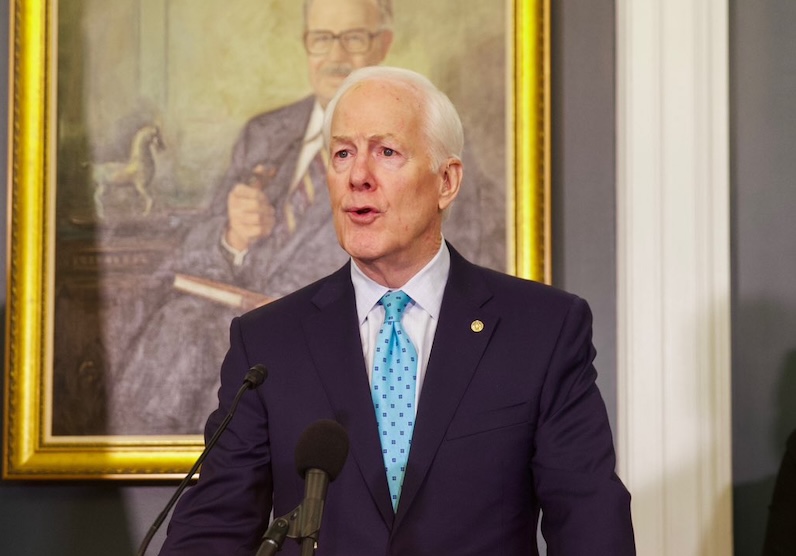
Texas – Republican leaders are holding back major support for U.S. Sen. John Cornyn as he faces Texas Attorney General Ken Paxton in a high-stakes GOP runoff, exposing growing divisions inside the party tied to Trump-aligned politics and broader ideological battles over the direction of the Republican establishment.
The hesitation comes even as national Republican fundraising operations prepare to spend heavily in other battleground states. A major Senate-aligned super PAC, the Senate Leadership Fund, recently announced a $342 million investment plan across eight states, but Texas was notably left out of the initial list of targets. The group, which plays a central role in Republican Senate campaigns nationwide, has not committed additional resources to Cornyn’s runoff at this stage, a signal that some party leaders are watching the race cautiously as internal dynamics unfold, HC reported.
Cornyn’s political position has become increasingly complicated as he trails Paxton in polling ahead of the May 26 runoff. The lack of unified establishment support has drawn attention from conservative activists aligned with former President Donald Trump, many of whom have criticized Cornyn as insufficiently aligned with the party’s more populist wing. Some influential voices on the right have argued that party resources should be redirected to other competitive races rather than invested in defending long-serving incumbents like Cornyn, reflecting deeper tensions within Republican politics.
At the same time, Trump has not issued an endorsement in the race, despite earlier signals that he might weigh in after the primary. That absence has further fueled uncertainty among donors and political organizations, leaving both campaigns in a more fluid financial environment than typical statewide runoff elections.
Inside Republican fundraising circles, Cornyn has historically benefited from strong establishment backing. During the primary phase, allied groups spent heavily to support him, including millions from Republican-aligned organizations connected to Senate leadership. However, recent reports show a shift in spending strategy. One major GOP-aligned network previously invested more than $10 million in Cornyn’s primary effort but has paused additional spending since the general field narrowed to the runoff.
Political observers note that runoff elections in Texas tend to be low-turnout contests dominated by more ideologically engaged voters. That dynamic often benefits candidates with strong grassroots enthusiasm, a factor that has been widely cited in Paxton’s favor. In a previous statewide runoff for attorney general, turnout dropped significantly compared to the primary, a pattern analysts say could repeat in the Senate race if enthusiasm differences persist.
Cornyn’s campaign has emphasized its financial advantage and organizational strength, arguing that it has the resources needed to expand turnout and communicate across the state. The campaign recently reported strong fundraising in the weeks following the primary and continues to rely on established donor networks and allied super PAC support to sustain advertising and voter outreach efforts.
Despite that, polling trends have largely shown Paxton ahead, with margins varying across surveys but consistently placing him in front. One exception came from a poll conducted by a Cornyn-aligned group, which showed the race effectively tied. Even so, many of the same polling firms had previously underestimated Paxton’s strength in the primary, where Cornyn ultimately outperformed expectations by a narrow margin.
Cornyn’s campaign spokesperson has argued that the senator’s previous overperformance demonstrates his ability to close gaps when it matters most, pointing to his long record in statewide elections and established voter network. The campaign has also highlighted recent fundraising totals and advertising investments as evidence that it is preparing for a sustained runoff battle.
On the other side, Paxton’s campaign has taken a more restrained financial approach, choosing to limit early advertising while relying on outside conservative groups and grassroots supporters to amplify messaging. Organizations aligned with Paxton have framed the contest as a broader ideological struggle within the Republican Party, emphasizing themes of constitutional rights, immigration enforcement, and opposition to establishment politics.
Conservative activist networks and advocacy groups have increasingly rallied around Paxton, portraying the runoff as a defining moment between establishment Republicans and a more aggressive, populist conservative movement. These groups have played a visible role in shaping online messaging and mobilizing supporters, helping to offset the traditional advantages held by establishment-backed candidates.
With the runoff approaching, both campaigns are preparing for an intense final stretch. Cornyn is relying on institutional support, fundraising capacity, and statewide infrastructure, while Paxton is leaning into ideological enthusiasm and grassroots momentum. The outcome is expected to have significant implications not only for Texas politics, but also for the broader direction of Republican strategy heading into the next general election cycle, where party unity and resource allocation will be critical in competitive Senate races nationwide.